
Reflections on the CMA2 Conference, Albuquerque 2026.
In addition to hosting a Fine Art Exhibition, the 2026 CMA2 Conference in Albuquerque also included an Exhibition of Site-Specific & Community Public Art Mosaics. As the exhibition’s committee chairperson, it was really important to me that we included these mosaic artworks. Many CMA2 members work in these realms and deserve recognition.
First and foremost, a shout-out to Sherri Warner Hunter, who took on the volunteer job of juror. The number of exhibition submissions far exceeded our expectations. There were 54 total submissions, and Sherri curated 21 site-specific and 11 community engagement projects into outstanding exhibitions.
Displaying large-scale works for an exhibition is always challenging. The conference committee decided to present the exhibitions as a video “loop” during lunch on Saturday at the conference, knowing a special presentation would be held online post-conference. As part of the conference plenary session, Lynn Adamo and Rochelle Schueler created a separate presentation highlighting the awardees in both categories. It was a fantastic presentation.
As part of the exhibition prospectus, artists were permitted to submit up to 10 photos, giving Sherri a real sense of the work involved, the teams it took, and a strong sense of what went into creating the artwork. Artists were also encouraged to elaborate on the artwork, the process, and the often-complex stories behind the projects. That additional information transformed the exhibition into something much deeper than a slideshow of finished mosaics. It became a window into the relationships, logistics, perseverance, fundraising, engineering, diplomacy, collaboration, and heart that site-specific and public art requires.
What struck me most while reviewing the submissions was the incredible diversity of approaches. Some projects transformed neglected urban infrastructure into vibrant landmarks. Others centered on healing, storytelling, environmental awareness, or cultural identity. One of the projects involved hundreds of volunteers over many years, while others were deeply personal, site-specific installations or community artworks created in response to a singular cause. Yet all of them shared something essential: mosaics have a remarkable ability to create connection.
Public mosaic art exists at the intersection of craft, architecture, storytelling, and community building. Unlike gallery work, these projects live in the real world. They face weather, budgets, permits, engineering constraints, public meetings, and the unpredictability of human collaboration. They become part of the daily lives of the people who encounter them. A mosaic installed in a school, transit station, hospital, bridge, library, or neighborhood plaza becomes woven into the identity of that place.
That is what made this exhibition so meaningful.
Again and again, the submissions demonstrated how mosaic artists are helping communities claim their identity, celebrate their history, honor their resilience, and imagine possibility. The works reminded us that public art is not simply decoration. At its best, it becomes a form of civic storytelling.
Among the projects recognized during the conference were several award-winning works that stayed with me long after the presentations ended.
Community Public Art Mosaics
Best of Show Watsonville Brillante, by Kathleen Crocetti
“Watsonville Brillante” stands as one of the most ambitious community mosaic projects I have learned about in the United States. The scale alone is extraordinary: a massive mosaic transformation of a multi-story parking structure in downtown Watsonville, California.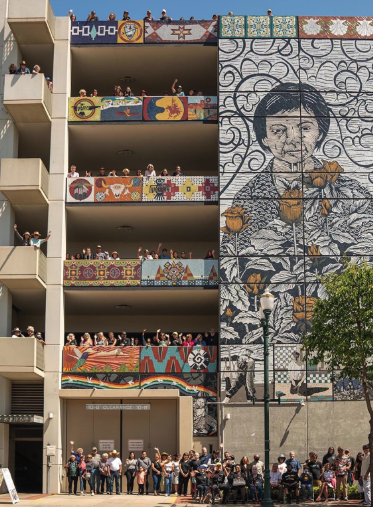
Crocetti’s work demonstrates what can happen when public art becomes a vehicle for community investment, cultural storytelling, youth engagement, and civic pride. The project includes designs representing the many cultural identities that make up the Watsonville community, alongside monumental imagery honoring agricultural laborers and the region’s history. The result is not simply a mural. It is a portrait of a community.
The project involved hundreds of volunteers, youth artists, interns, donors, local businesses, and community members. That kind of undertaking requires extraordinary organizational skill and endurance. Public art at this scale is not glamorous. It involves years of planning, fundraising, fabrication, installation logistics, partnerships, and problem-solving. Click here to learn more about Kathleen.
And yet, projects like “Watsonville Brillante” prove that mosaics are uniquely suited to long-term community engagement. Bit by bit, tesserae by tesserae, people contribute to something larger than themselves. Each participant leaves a physical trace of their labor and presence embedded in the final artwork.
I also appreciate how the project challenges outdated assumptions about what public art can be. A parking garage — often considered purely utilitarian infrastructure — has been transformed into a landmark and cultural destination. That transformation matters. Art changes how people feel about a place. It changes how they move through it. It changes how they identify with it. of community mosaic practice.
Honorable Mention Rise Above, by Diane Sonnenberg
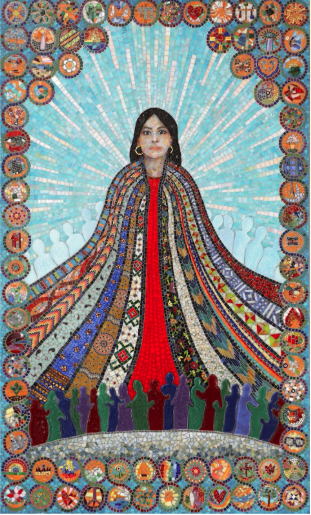 Diane Sonnenberg’s “Rise Above” carried a message that resonated strongly throughout the conference. The title alone speaks to resilience, perseverance, and hope.
The artwork was created to honor 14 women in Austin who won a lawsuit against the DA, city, and police for the mishandling of their sexual assault cases. As a part of their restitution, they asked for an art piece as a reminder of the importance of justice.
Public art frequently emerges from communities facing challenge, transition, or recovery. Artists working in these environments often become facilitators of healing and connection. While mosaics cannot solve systemic problems, they can create spaces where people feel seen, valued, and inspired.
“Rise Above” embodied that spirit beautifully. Over 80 people came together to create the mosaic—survivors, officials, families, and mosaic artists. Click here to learn more about Diane.
I was especially moved by the piece’s emotional clarity, and at the same time, the artwork carries a profound social impact.
Honorable Mention Hanging by a Thread, by Kim Wozniak
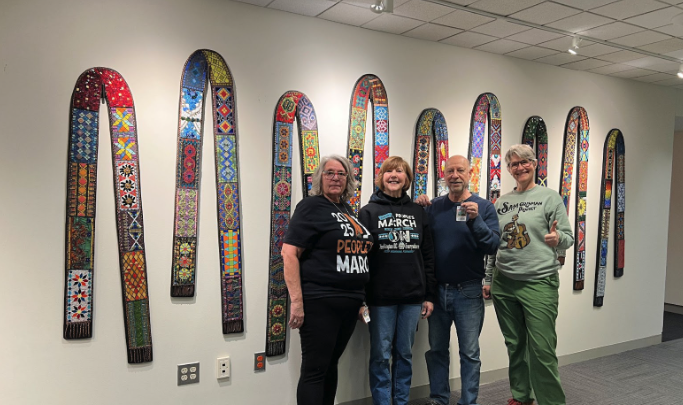
Hanging by a Thread by Kim Wozniak received Honorable Mention in Community Public Art and is part of a powerful international mosaic collaboration responding to the crisis faced by Afghan women and girls since 2021. Under Taliban rule, access to education, work, and artistic expression has been severely restricted, and cultural life has been profoundly diminished. In response, mosaic artists worldwide created monumental scarf installations symbolizing resilience, identity, and collective voice.
The project, conceived by Bady Essid Jaballah (Tunisia) and artistically guided by Madeleine Turgeon (Canada), with coordination from Tamara Froud of BAMM, includes contributions from over 1,300 artists in 40 countries. Each 10 x 25 cm glass segment reflects Afghan textile traditions across 34 provinces and diverse ethnic groups.
Kim Wozniak led the U.S. contribution, creating nine scarves that are part of The World Bank’s permanent art collection in Washington, DC. Learn more about this project on the Make it Mosaics YouTube channel.
Honorable Mention Intertwined – Mosaic of the Community Brain, by Alison MacCormaic
Alison Mac Cormaic’s “Intertwined” is a science-inspired community mosaic developed through the EU Horizon program, STE(A)M Learning Ecologies, as one of ten pilot projects across Europe focused on open schooling in science education.
The work draws inspiration from brain cells viewed under a microscope, transforming scientific observation into collaborative art. Students’ mosaic pieces act as cell nuclei, reaching outward and connecting with one another to form a network of shared ideas, images, and experiences. Visually, the work emphasizes movement and connection, while conceptually it reflects interdependence and collective learning. Click here to learn more about Alison.
“Intertwined” also mirrors the spirit of the conference itself, where artists gathered in Albuquerque to exchange ideas, build relationships, and spark new collaborations across disciplines and communities.
That sense of connection is one of CMA2’s greatest strengths.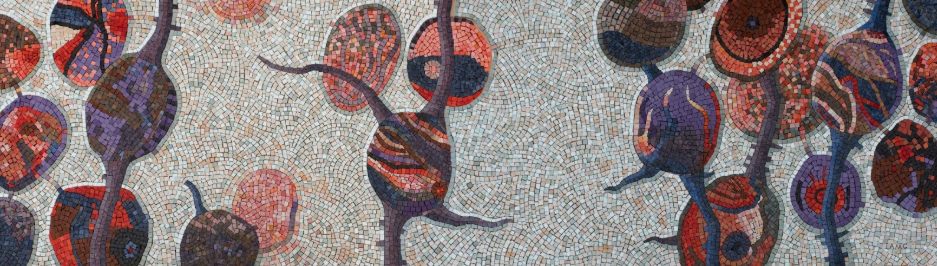
Site-Specific Mosiacs
Best of Show Cascadia, by Jennifer Kuhns
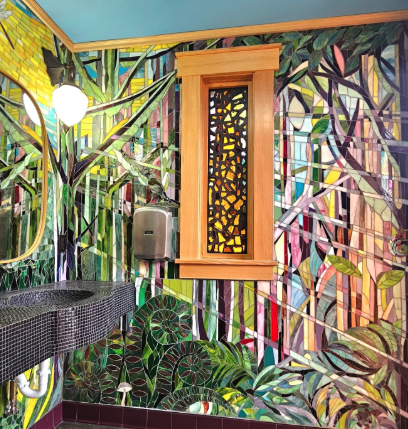
Jen Kuhns’ “Cascadia” is a powerful example of site-specific mosaic art that feels deeply connected to the landscape it inhabits. Inspired by the Pacific Northwest, the work captures the movement and rhythm of water, forests, shifting geology, and interconnected ecosystems. The mosaic carries both visual energy and emotional depth, drawing viewers into its flowing patterns and layered textures. What makes the piece especially successful is its strong sense of place. Rather than feeling imposed upon the environment, “Cascadia” appears rooted within it, as though it naturally emerged from the land itself. Kuhns also demonstrates one of the great strengths of contemporary mosaic practice: the ability to unite beauty with meaning. Click here to learn more about Jen.
While viewers may first respond to the color and scale, the deeper themes of memory, migration, and environmental connection gradually unfold over time, allowing the work to resonate long after the initial encounter.
Honorable Mention Dig Deep, by Stacia Goodman
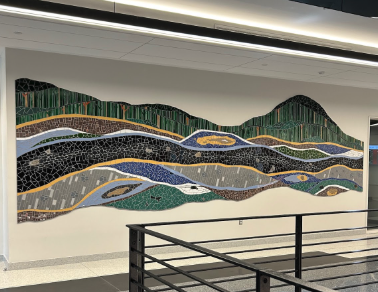 “Dig Deep” by Stacia Goodman is a sweeping mixed-media mosaic created for the Education & Health Sciences Center at Frostburg State University. Inspired by the geology, waterways, forests, and layered history of Maryland and the Appalachian region, the artwork invites viewers to look closely and discover hidden details woven throughout the composition. Goodman incorporated fossils collected by geology students, bobcat
tracks honoring the university mascot, hand-made ceramic elements, mirror, glass, and stone to create a richly textured visual narrative. “Dig Deep” celebrates curiosity, connection to place, and the beauty found beneath the surface. Click here to learn more about Stacia.
Honorable Mention Cosmic Flow, by Nancy Keating
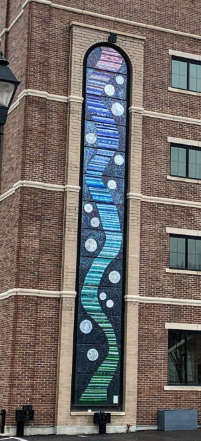
Nancy Keating’s “Cosmic Flow” is a vibrant mosaic installation that explores movement, energy, and interconnectedness through sweeping lines, luminous color, and intricate detail.
Inspired by the rhythms of nature and the vastness of the universe, the artwork evokes flowing water, celestial patterns, and unseen currents that connect all living things. Keating combines carefully cut glass, stone, and reflective materials to create a dynamic surface that shifts with changing light and perspective.
The piece invites contemplation while radiating joy and motion, encouraging viewers to pause, look closely, and experience the sense of wonder and balance embedded within the mosaic. Click here to learn more about Nancy.
Honorable Mention, Fisher Family Portrait by Jolino Bessera
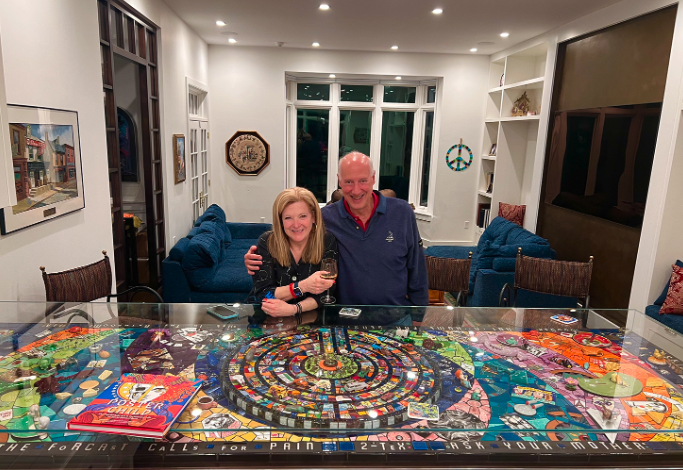 Jolino Bessera’s “Fisher Family Portrait” is a joyful, site-specific mosaic that celebrates the beauty, humor, memories, and dignity found in family life. Created for the heart of the client’s home, the artwork balances storytelling with function, transforming a lived space into a deeply personal work of art. Bessera’s signature style of vibrant colors, playful details, and expressive imagery captures moments of connection, warmth, and shared experience. “Fisher Family Portrait” serves as both a celebration of togetherness and a lasting visual archive of family memory. The piece beautifully demonstrates how mosaics can preserve stories, emotions, and human connection for generations to come. Click here to learn more about Jolino,
In closing, one of my goals behind including the Site-Specific & Community Public Art Mosaic Exhibition was to broaden the conversation around what mosaic art can be.
Fine art exhibitions are important and inspiring, but community-based and public mosaic projects deserve equal recognition because they require a different — and often incredibly demanding — skill set.
Public artists must think like designers, engineers, project managers, teachers, fundraisers, communicators, collaborators, diplomats, and problem-solvers. They navigate city approvals, public feedback, budgets, safety concerns, weather, and installation logistics. Many of these projects unfold over years.
Public mosaic projects create opportunities for intergenerational collaboration. They activate neglected spaces. They preserve stories. They engage youth. They foster civic pride. They invite participation from people who may never step inside a gallery.
And perhaps most importantly, they create permanence in an increasingly temporary world. Mosaics endure.
The exhibition reminded all of us that mosaic art is not confined to galleries or private collections. It lives in neighborhoods, schools, transit stations, parks, libraries, hospitals, sidewalks, bridges, and city centers. It lives wherever people gather.
And perhaps that is where mosaic art has always belonged.
Because at its core, mosaic is about connection — small individual pieces coming together to create something larger, stronger, and more meaningful than any one fragment could achieve alone.
That truth was visible in every project included in the exhibition.