
As part of the Contemporary Mosaic Artist (CMA2) Conference, Connecting Mosaic Artists: Building Community, two art exhibitions came to life—Fine Art and Site-Specific & Community Mosaic Art. I’ve participated in juried shows before. This time, I stepped behind the curtain as an organizer. Let me just say… I now have a whole new level of respect for anyone who has ever pulled off an exhibition without losing their mind (or their clipboard).
This post focuses on the Fine Art exhibition—what I observed, what surprised me, and what might be useful if you’re looking for ways to more deeply experience creating and viewing fine art mosaics. I will address Site-specific and Community Mosaics in a future post. I also hope to share additional artworks from the Fine Art exhibition in future posts. The few artworks used in this post I selected because they best illustrate the insights I share here.
The exhibition, Pieces of Us, ran from March 2026 through March 2026 at The Gallery ABQ in Albuquerque. The gallery is artist-owned and thoughtfully run. They were terrific partners: professional, flexible, and—yes—artwork sold. Twenty of the sixty pieces in the Salon space found new homes. Needless to say, a thrill.
Deep gratitude goes to our jurors—Kim Emerson, Kim Wozniak, and Jolino Beserra—each bringing care, time, and a discerning eye to the selection process.
The Artist Statement (Yes, That Thing)
Let’s talk about artist statements for a minute. They can feel a bit like walking a tightrope—too vague, and they say nothing, too heavy, and they can overwhelm the work. Sometimes you’re asked to describe yourself as an artist. Other times, like in this exhibition, the focus is on the specific artwork: the idea, the process, the why behind it.
The prospectus required an Artist Statement specifically about the artwork. What surprised me most was how reading these statements altered my perception of the work.
Some were deeply personal. Some spoke to shared experiences—Covid, uncertainty, the state of things in America. Others were rooted in materials exploration, where the medium itself became the message. Together, they created a kind of quiet chorus behind the visual work, highlighting the subtle but powerful interplay between statement and art. With this connection in mind, other aspects of presentation, like artwork titles, also stood out.
Artwork Titles: The First Handshake
Titles do more than label a piece. They quietly guide the viewer in. Titles can hint at intention, frame a theme, or offer just enough direction to open a door. They don’t give everything away.
I came across a line from Sergio Jackson that stuck with me: “titling a work is part of the art itself—it’s the first handshake between the piece and the viewer”. Before materials, before technique, the title often sets the tone. A strong title doesn’t need to explain the work. It can deepen the experience—nudging curiosity, suggesting a narrative, or sharpening an emotional edge. The titles in this exhibition offered many of these “good handshakes.” They invited you in, then let the work do the rest.
What I Was “Hearing” About the Show. A few themes kept coming up in conversations and feedback:
- “Beautifully displayed.”
The gallery space was intimate—small. However, the excellent curation made it feel intentional and cohesive. - “The materials are being pushed.”
Artists are experimenting. They are stretching what mosaic can be, bending – and at times breaking the rules. - “There’s meaning here.”
Whether subtle or direct, many pieces have emotional or social weight.
That final observation remained with me. A spark of inspiration.
So… What Do I Do With This Spark?
With these experiences and feedback in mind, I reflected on how they might influence my own practice. Truthfully, I was moved—more than I expected. Often, it was the combination of the work and the words that created the impact.
Here’s where I’ve landed for now: I want to be more intentional about why I’m making something—not just how. And I want to challenge my artist friends to take this walk with me for a bit….
- Let the materials speak, but do not hide behind them.
- Take more risks in content, not just technique.
- And yes… take artist statements a little more seriously, the why is a worthy conversation. Don’t treat the statement as an afterthought.
Thinking about exhibiting your work? Do it! Who knows, your piece might just be one of the ones that stays with someone long after they’ve left the room. The online version of Pieces of Us will be available through the CMA2 website following the public presentation on April 12, 2026. The artwork and statements I share here are with the artists’ permission and will be a part of the online exhibition recording.
For those of you interested in learning more about the awardees and seeing the artwork, visit the CMA2 website. You need to be a member to access the site. If you create in the Mosaic Art space, I encourage you to check it out. www.contemporarymosaicart.com
Any questions, drop me a note. bonnie@maverickmosaics.com
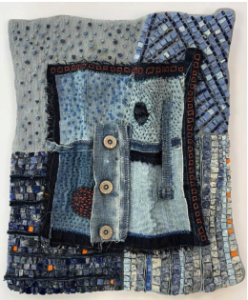
Denim Memory by Lynn Adamo
I’ve been interested in combining hard and soft materials in my work for some time. First using felt with my stone and smalti, then exploring burlap with rusted metal and smalti. Currently enjoy marrying the slow, meditative process of hand stitching with the slow and deliberate process of mosaic.The denim portion of this piece evolved over a year’s time. It began with pieces of a beloved pair of overall shorts that had finally worn out. I couldn’t bear to throw it away, so I turned it into art material! I love the connection between building lines with stitch and building lines with mosaic. This mosaic design echoes the design I created with denim and stitch. 14 x 11 Azul Bahia, azul sodalite, smalti, litovi, ceramic, apoxie sculpt, filati, denim, stitch with tinted mortar on hand-formed mortar, and mesh substrate.
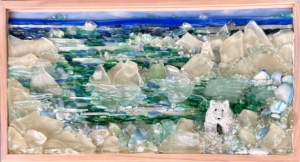
Endangered 2 by Laura Rendlen.
Two years after joining the Society of American Mosaic Artists (SAMA), I received the Robin Brett Scholarship. I used the grant to take workshops, and in Sherri Warner Hunter’s class I built a three-foot polar bear. It was a game changer for my artwork. After I covered him in white marble and smalti, he traveled with me through twenty years of my career until he was stolen from outside my storefront. Along the way in my mosaic journey, Crystal Wozniak (WitsEnd and Smalti.com) gifted me a box of tumbled glass and tile. I opened it and immediately thought, “This is the Arctic in a box.” That’s how it has always been for me in mosaics: the materials can lead the inspiration. They reveal a place, a setting, a world they belong to. As I began building this icy landscape, I knew I had to recreate the bear. He belongs there. And he still carries the message of his endangered ecosystem. Tumbled glass, stained glass, glass tile, tempered glass, marble, fluorite, tumbled pottery shards, wire armature smalti, selenite and other minerals. On GoBoard with thinset. 13.5 × 25.5 × 1.5
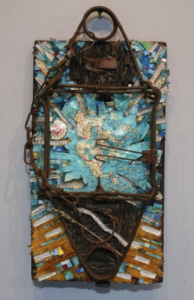
Trapped in America by Cindy Robins
This piece was created from my tears…. The anger, the sharpness, the division of our country makes most of us feel trapped in a strange new world. While many are being disappeared, the rest of us are confronted by daily lies, rule changes, politic turmoil and grief. Every day brings a different reality, causing us to feel as if we have lost our foundation. We have to strive to keep moving towards some sort of faith in humanity. We have to “stand for honesty, love and respect of all living beings” Through our resistance, there are signs of hope. Vintage beaver trap, vintage world globe, stained glass, slate, smalti, paper, tempered glass. 17 x 8 x 2
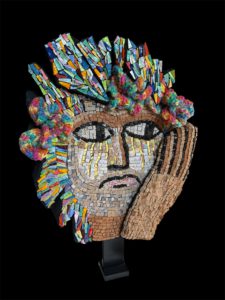
Should I Be Worried Linda Fisher
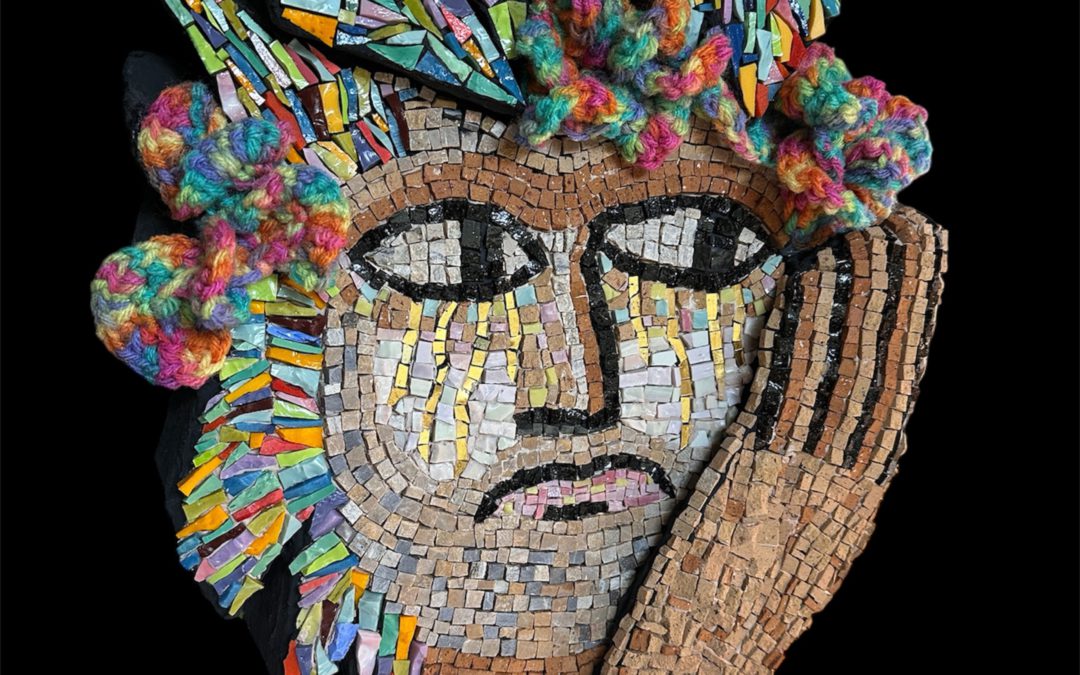
Should I Be Worried was first created as a digital drawing in 2020, at the height of the COVID-19 pandemic. I was living in New York then, when daily death counts, constant sirens, and the fear of an invisible virus shaped every moment. The title reflected a very real, immediate anxiety: there was, quite literally, so much to be worried about. Today, I find myself still living in a state of worry, but for different reasons. The fear has shifted from a public health crisis to a crisis of democracy. With these concerns in mind, I have resurrected Should I Be Worried as a mosaic, many small, fractured pieces forming a larger whole. This new iteration carries forward the lingering question from 2020, asking whether our collective unease is a passing moment or a warning we can no longer ignore. The piece quietly asks: is this just my worry, or our worry? Laticrete Hydro Ban Board, thinset, smalti, Hyberbolic Crochet. 17 x 13 x 3
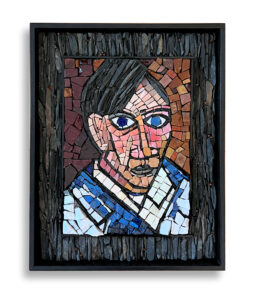
Pablo Bonnie Fitzgerald
This mosaic is inspired by Picasso’s 1907 self-portrait, a painting that’s always grabbed me with its raw energy and emotion. I wanted to explore that same feeling through the textures and light of mosaic—using smalti, shale, stained glass, and glass rods to build depth and movement. The rich reds bring warmth and intensity, while the shale hair and frame add an earthy texture that grounds the piece. Set within a shadow frame, it takes on a sculptural presence, almost like the portrait is pushing forward from within. Smalti, shale, stained glass, filati. 11 x 14
Click individual artists names here to their websites. Laura Rendlen, Cindy Robin, and Linda Fisher can be found on the CMA2 website or through the Austin Mosaic Guild.